
Let's Set Things Wright
I messed up.

Four years ago, I competed in a speech competition at the University of Utah. I was at a point in my life, like many students, where I would do (almost) anything for money. Even risk humiliation through public speaking.
The speech could be on anything, but it had to be a topic I was passionate about. It took about 14 nanoseconds to come up with something.
I had recently read the introduction to Caroline Criado Perez’s Invisible Women.1 Perez’s thesis is simple: we live in a world where men are the default, and this gender gap in research and data disadvantages and endangers women. Despite our obvious biological and anatomical differences, cars are not tested for women; women are rarely the subjects in medical research; even our phones are tested on and made for male hands. Everything from urban planning to the temperature of our offices is based on men’s experience. Women live in a man’s world and wonder why it’s so hard.
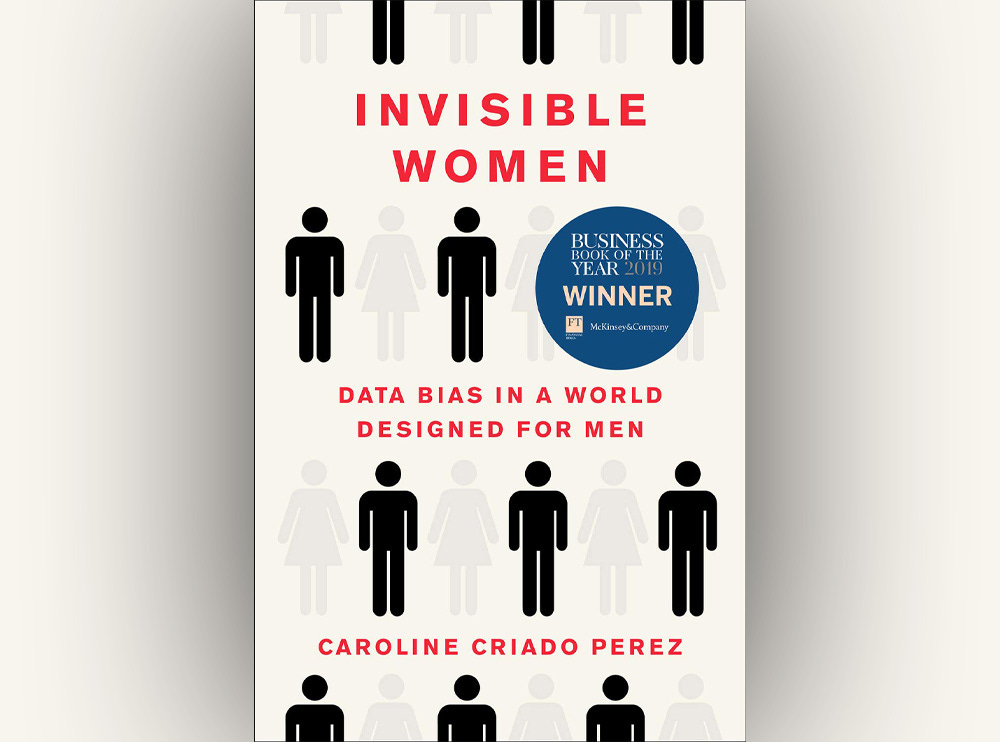
I’m trying not to be dramatic, but this book and that speech changed my life’s trajectory. I applied for and received a Fulbright grant to study women’s political participation in Portugal in 2023. I started working with the Utah Women and Leadership Project as an associate researcher, studying the status of women in the state I grew to love. I gave birth to the third female president of the United States. I started this award-winning (pending) Substack.
My eyes had been opened, but I still sometimes struggle to recognize the accidental sexism and gender bias I am innocently perpetuating.2
All of this to say, I messed up.
I wrote about the Wright Brothers’ first flight earlier this year. However, this was before I took the pink pill (not this one, a different one) for the newsletter. I was ticked at myself when I realized I had failed to notice the woman behind it all.
I had forgotten that when something significant happens in history, women are always there. You just have to look for them.
So today, we’re headed back to Kittyhawk. But move aside, Orville and Wilbur! We want to talk to your sister.
Katherine “Kitty” Wright Haskell: The Forgotten Wright Sibling
She’s easy to remember. Kittyhawk. Kitty Wright. Boom. Let us never forget.
The Wright Brothers National Memorial towers over the windswept dunes of Kill Devil Hills, North Carolina, commemorating the place where man took flight. Looking closely, however, you’ll notice something missing. Among all the plaques and monuments celebrating Orville and Wilbur’s first flight, there’s barely a whisper about Katharine Wright—the sister who kept their household running, charmed investors, managed the press, and championed her brothers’ work in public. There would be no Wright Brothers without their smart, charismatic and capable younger sister. It’s time we know about her.
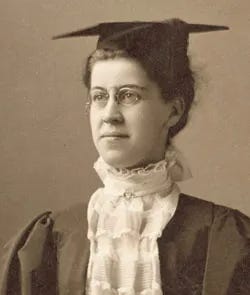
Katherine was the last of five Wright children, and the only girl. After her mother died from tuberculosis, Katherine managed her home and cared for her preacher father and two of her brothers at home - the not-yet-famous Orville and Wilbur. A progressive and intellectual woman, she was the only person in her family to graduate from college in 1898. After graduating, she was determined to establish financial independence. She got a job teaching Latin and English in Dayton, Ohio. And while she loved the work, she complained of earning less money than her male peers, and being assigned less-desireable classes. This exposure to gender-based inequality would influence the rest of her life.
Her brothers, who had “neither independent resources nor government support,” relied on their sister and on their small income from their bike shop. While they were off conducting flight experiments, it was Katherine who ran the shop, balanced the books, and managed their press. When Orville crashed and nearly died in 1908, Katherine quit her job and spent weeks nursing him back to health.
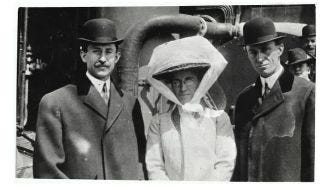
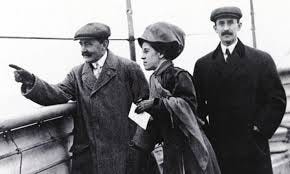
Katherine was the charming diplomat and PR expert that her shy, awkward brothers desperately needed. After Orville recovered from his crash, she sailed with him to Europe. The siblings demonstrated their new invention to governments and the public, trying to convince the world of the possibility of flight. She learned French to help negotiate European contracts, charmed kings and presidents, and became the public face of Wright aviation. She flew multiple times, shocking audiences who believed women were too delicate to fly (and we are! Much too delicate to fly economy. First class only, please. Business plus might be okay. It’s for our biology and stuff). The French government, impressed with Katherine called Kitty, honored her as an Officier de l’Instruction Publique, one of France’s highest academic distinctions.
A pioneering feminist, Katherine contributed to suffragist groups and even marched (with her father and two brothers, which I think is very cool) for the vote in 1914. She would write:
“I get all ‘het up’ over living forever in a ‘man’s world,’ with so much discussion about what kind of women men like and so little concern over what kind of men women like... Orv always teased me about that. When we were working for [suffrage], he used to say that women’s suffrage was like Rome, in one respect: all roads led to it, with me.”
Oh, Katherine. You would have loved Invisible Women.
Katherine’s impressive life was cut short, but not before a moment of happiness and scandal (it’s unfortunate how often those overlap). In 1926, at the age of 52, Katharine committed the unforgivable sin of marrying Harry Haskell, a Kansas City newspaper editor who had been her friend since college. Her beloved brother Orville responded by cutting her out of his life completely. I’m going to give him the benefit of the doubt and assume he just really missed his sister. Or maybe he had grown dependent on her and was suddenly losing his secretary, PR manager, accountant, personal assistant, maid, cook and companion. Come on, man. Let her live a little.
And she did live…a little. Three years after getting married, and about to set off on their belated honeymoon, Katherine caught pneumonia and died. In her last moments, Orville was at her side, finally willing to forgive her for choosing herself, just once.
Not being famous isn’t the worst fate in the world, and I doubt Katherine really cares whether history books remember her or if there are monuments in her name. Most of us live and die in relative obscurity. But most of us did not have a key role in the invention of manned and womanned flight.
Her unseen, unpaid and uncelebrated labor was the solid ground her brothers needed to take off. Thinking about the millions (billions?) of women like Kitty is a little overwhelming, but I am inspired by them. As a woman in a man’s world, we need to remember and honor these forgotten women. Knowing their stories is like Rome for me: all roads lead to it.
I did eventually read most of the book
Did I win the speech contest? That’s for another essay. (Comment if you care, and I’ll publish it.)
i love kitty!
Oh I loved this so much! It’s so fun to learn more about these forgotten sisters in history, especially in your witty way of telling their stories. And hell yes to first class flights for women! The least the world can do, really.